Begin with the work already done.
Local-first guidance and authorised task state aim to avoid rebuilding context at every step. Measure the benefit against the cost of keeping it available.
Keddeh Systems / Green Futures
Imagine a workshop, factory or office where people have the right context, equipment has a clear role and useful work does not start from scratch every time.
Connected-workplace design and a testable roadmap. Environmental benefits remain to be measured.
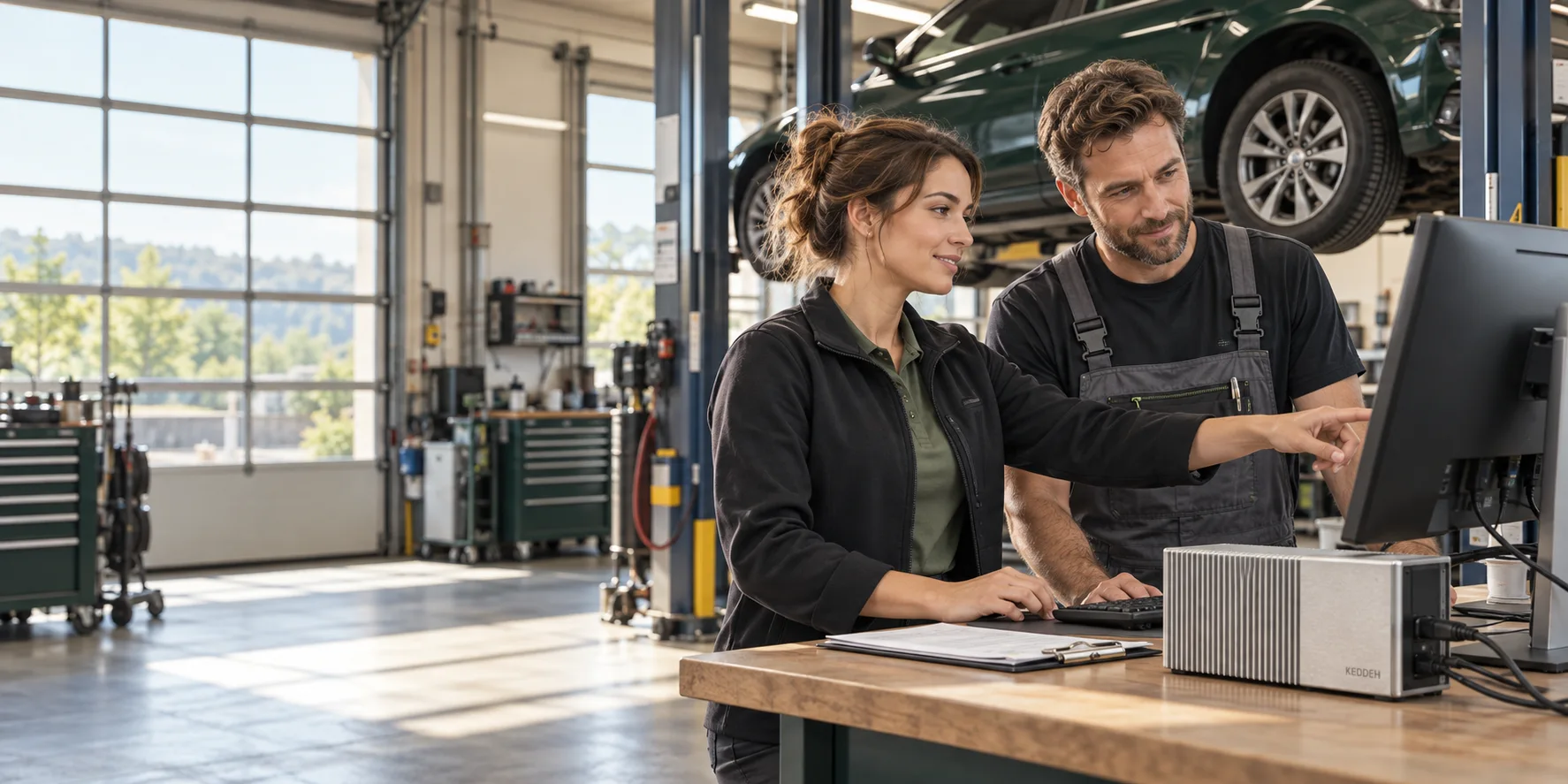
Start with one repeatable job. Record the people, devices and services it needs, what can be reused, and the result that counts as completion. The next step is to compare that defined workload against a measured baseline.
A future worth building
Green futures start with everyday decisions: what needs to run, what can be reused, what should stay close to the work and what deserves a longer service life.
Local-first guidance and authorised task state aim to avoid rebuilding context at every step. Measure the benefit against the cost of keeping it available.
Structured file identity and recursive application components offer a path to less duplication. Reconstruction and validation remain real work.
Modular hardware aims to make maintenance and upgrades more targeted. A longer service life and lifecycle benefit must be demonstrated in use.
Choose your environment
Follow a person through an illustrative day-to-day task. Each environment connects guidance, documents, equipment and services without treating them as one unrestricted agent.
A technician arrives with a job to finish. The guide brings the relevant instructions into view, while the equipment keeps its own bounded role.
The person describes the repair. A local IL-LLM guide uses permitted job information, rather than starting from a blank conversation.
A file agent locates the authorised procedure and its identity. Reconstruction requires the referenced state and dependencies to be available.
The guide proposes a step; the person approves any handoff. An equipment agent can only use its permitted operations.
BRAINK augmented learning can relate an observed outcome to the task. Changed equipment or uncertain state calls for review.
Illustrative integration: neither this page nor the guide operates live machinery. Interlocks, isolation and safety-rated controls remain separate.
In a factory energy room, a useful assistant helps an operator compare what was requested with what the equipment actually did.
A local guide presents permitted equipment context and meter readings, when connected and validated.
The file agent supplies the correct procedure. The equipment agent has a distinct identity and bounded command set.
The operator reviews the proposed action and its limits. No chat instruction bypasses electrical protection or site procedures.
Readback, exceptions and drift constraints keep a request distinct from a verified physical outcome. Measure energy across the same boundary.
Proposed integration, not an installed energy-management system. Switching, protection, metering accuracy and load ratings require target-specific engineering.
A team needs the current document, the right service and a clear next step. Connected local context aims to reduce repeated setup across everyday work.
The local IL-LLM guide uses an authorised task context. Remote capabilities are brought in when the task requires them.
Double-wrapped HTML and VFS composition describe reusable, nested application components, with explicit dependencies and access boundaries.
A file agent handles the permitted state; another service receives only the authorised handoff. Reconstruction still takes resources.
BRAINK augmented learning supports task continuity. Changed sources, permissions or outcomes trigger a check rather than silent drift.
Illustrative workflow. Local deployment is not automatically more energy-efficient: idle power, model size, utilisation and remote work all matter.
Evidence before promises
The energy case must connect working software to a representative physical deployment. A design relationship alone does not establish power consumption, safety or a whole-system saving.
These published guides, workflow choices and local calculator are software experiences. Their operation is testable; it does not verify a deployed equipment agent or energy benefit.
Local-first IL-LLM guidance, BRAINK augmented learning, bounded agents, state reconstruction and modular power, compute and connectivity form the proposed integration.
No measured whole-system Keddeh energy saving is presented here. Equivalent task quality, idle load, networking, cooling, reconstruction and remote compute must be included in a fair comparison.
Define one workload, engineer its interfaces, record a baseline, compare repeated runs and publish the boundary and uncertainty. Expansion depends on the result, not a promised date.
A connected architecture
IL-LLM is the local-first guidance layer; BRAINK provides augmented learning in the architecture. A guide agent, file agent and equipment agent retain separate responsibilities. Permissions, authorised handoffs, identity and drift constraints define where an action may go. Local-first is a deployment approach, not proof that every workload should run locally.
Vector relationships and KEX seed DNA describe identity and state reconstruction from defined seeds, rules and available dependencies. A finite seed cannot encode infinite arbitrary data. Recoverable content depends on the information actually present, available or generated by specified rules. Recovery, validation and transmission still consume time and energy.
The design composes an inner application with an outer carrier, using a virtual file system (VFS) and nested components to preserve structured relationships. Reuse may reduce repeated copying, loading or recomputation where the workload supports it. Dependency management, isolation and the full cost of reconstruction still need testing.
The BRAINK hardware concept separates modular power, compute and connectivity so an integration can be engineered around its actual equipment. Replaceability may support a longer service life; manufacturing, maintenance and end-of-life impacts require separate lifecycle evidence. No certification or universal equipment compatibility is claimed.
The workflow and its limits are explained above. Use a reference when you need the underlying source, equipment scope or implementation status.
A useful next step
Choose one workshop, factory or office task. List its devices and services, record the present process and define the result that must stay equivalent. Then use the dated operating inventory and editable conventional baseline to plan the comparison.
The comparison distinguishes observed service counts from hypothetical bills and energy estimates. Actual Keddeh energy savings remain unknown.